
Aquahenosis: What New Research Says About Floating and Altered States of Consciousness
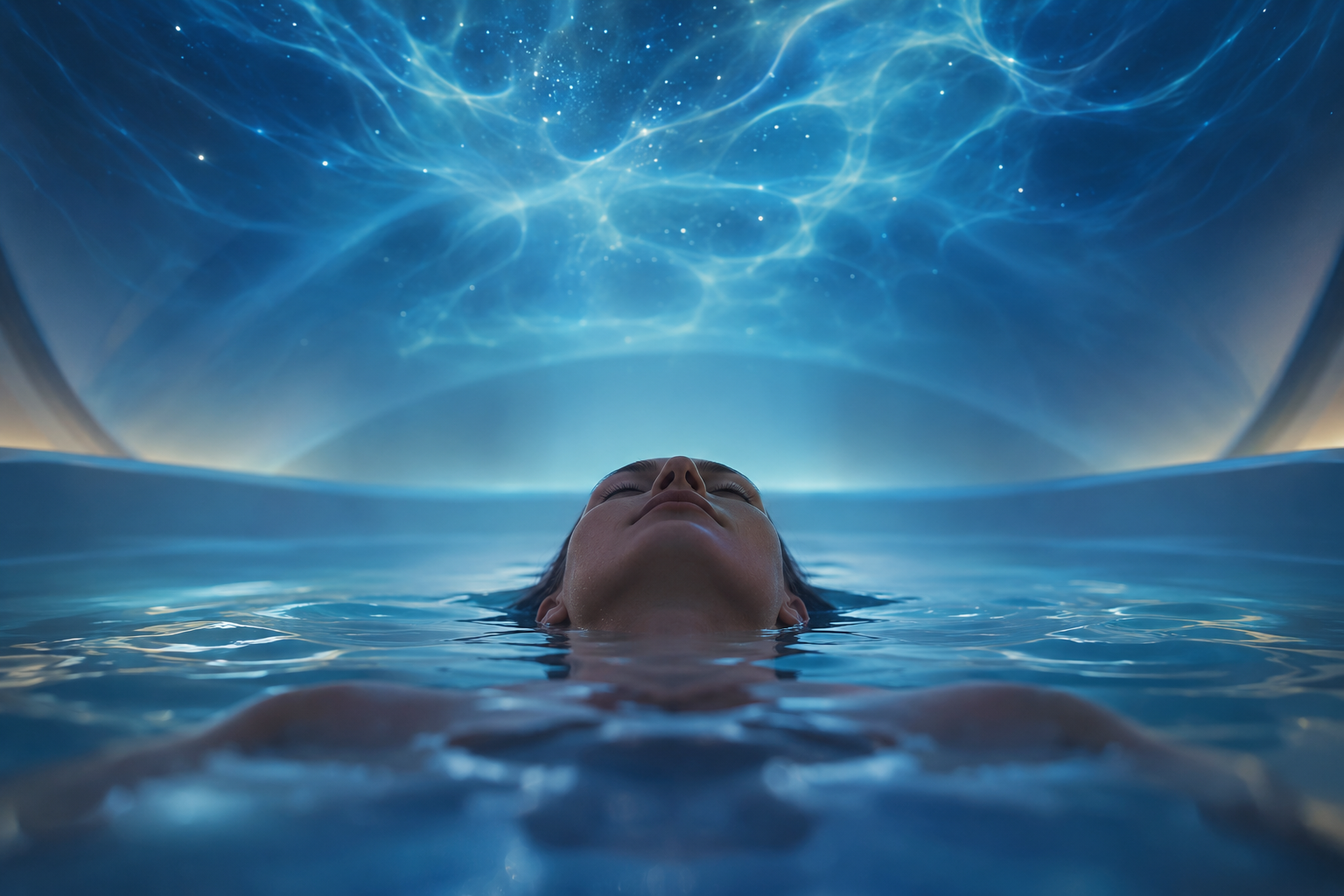
Anyone who has floated enough times has probably had a session that was difficult to describe afterward.
Maybe you lost track of time.
Maybe your arms and legs seemed to disappear.
Maybe it became difficult to tell where your body ended and the water began.
Maybe your thoughts got unusually quiet — or went somewhere unexpected.
For years, floaters have described experiences like these. Now researchers are getting increasingly interested in them too.
A growing body of research suggests that Floatation-REST doesn't simply create a state of deep relaxation. Under the right conditions, it can also produce measurable altered states of consciousness involving changes in our perception of the body, time, and the boundary between ourselves and the environment.
And researchers recently gave this particular constellation of experiences a name:
Aquahenosis — “oneness with water.”
Wait. An altered state of consciousness?
That phrase can sound more dramatic than it needs to.
An altered state of consciousness simply means that our subjective experience becomes noticeably different from our ordinary waking state.
Meditation can do this. So can dreaming, intense exercise, breathwork, hypnosis, music — and, of course, certain psychoactive substances.
Floating may offer another route.
But instead of adding something to consciousness, Floatation-REST largely works by taking things away.
Light fades.
Sound fades.
Gravity becomes much less noticeable.
The water and air are close to skin temperature.
Movement becomes unnecessary.
The usual stream of external information arriving at the nervous system becomes dramatically quieter.
What's left is a very unusual environment for the human brain: one in which there is remarkably little outside information competing for attention.
And that appears capable of changing the experience of being inside your own body.
When the edges of the body start to disappear
A 2024 study published in Scientific Reports compared 60 minutes of Floatation-REST with 60 minutes spent lying on a warm waterbed in a dark, quiet room.
That comparison is important.
The control group wasn't sitting at a desk answering emails. They were already resting in a comfortable, low-stimulation environment.
Even against that fairly strong comparison condition, floating produced more pronounced alterations in consciousness.
Participants experienced a greater dissolution of perceived body boundaries and a stronger distortion of subjective time. They also reported greater relaxation and larger reductions in anxiety than after the waterbed condition.
Even more interestingly, the researchers found that the weakening of perceived body boundaries statistically mediated the reduction in anxiety.
In other words, the strange sensation of your body becoming less distinct from its surroundings might not simply be an amusing side effect of floating.
It may be part of how the experience changes the way we feel.
That doesn't mean dissolving your body boundaries is a guaranteed treatment for anxiety. This is still an emerging area of research.
But it raises a fascinating possibility:
Perhaps part of floating's power comes from temporarily changing the way we experience ourselves.
What actually happens during a float?
Another study published in 2026 tried to answer that question in an unusually detailed way.
Instead of simply giving participants questionnaires, researchers conducted extensive interviews after their floats to reconstruct the subjective experience moment by moment.
Fourteen participants completed Floatation-REST sessions, and researchers found a surprisingly consistent progression.
Most experiences moved through roughly four stages:
Acclimatization — settling into the unfamiliar environment.
Transition — bodily and mental sensations beginning to change.
Altered state — deep relaxation accompanied by changes in body, thought, space, and time.
Reorientation — gradually returning attention to ordinary surroundings.
During the altered-state portion of the float, participants commonly described positive emotions, deep relaxation, reduced bodily sensation, fewer thoughts, and losing their ordinary orientation in space and time. These changes tended to emerge gradually and intensify as the session continued.
If you've ever spent the first 15 or 20 minutes of a float wondering whether you're “doing it right,” this research is worth remembering.
Sometimes the interesting part comes later.
Enter Aquahenosis
Then came a 2026 study published in Neuroscience of Consciousness.
Researchers analyzed data from 75 treatment-seeking adults experiencing anxiety and depression who had been randomized to six sessions of Floatation-REST or a reclining zero-gravity-chair comparison condition. Participants completed a widely used questionnaire for measuring altered states of consciousness — the same family of measurements often used in psychedelic research.
The float participants showed a distinctive pattern.
Researchers found increases in experiences described as:
Oceanic Boundlessness — a positively felt weakening of the usual boundary between self and world.
Disembodiment — changes in the ordinary sense of where and how the body is located.
Experience of Unity — a sense of connectedness or diminished separation.
Participants also showed greater awareness of internal bodily signals such as breathing and heartbeat.
The researchers called this particular state aquahenosis.
Oneness with water.
It's a remarkably appropriate word for something floaters have struggled to explain for decades.
So... is floating like psychedelics?
Here's where the research gets especially interesting — and where it's important not to overstate things.
The researchers compared the experiential profile of Floatation-REST with previously collected data involving psilocybin and ketamine.
They found overlap in certain dimensions, particularly disembodiment, experience of unity, and blissful states. Some aspects of the float experience resembled those reported with low-dose psilocybin or ketamine.
But that does not mean floating is equivalent to taking psychedelics.
There were important differences.
The strongest similarities involved changes in self-boundaries and embodiment. Psychedelic experiences — especially at higher doses — produced substantially more visual phenomena, perceptual changes, complex imagery, and other sensory distortions.
So the interesting takeaway isn't:
“Floating is basically psychedelics without drugs.”
It isn't.
A more accurate interpretation is that human consciousness may have several ways of reaching certain unusual experiential states.
Some involve adding a powerful chemical stimulus.
Floating takes almost the opposite approach.
It removes stimulation.
Yet both routes can sometimes alter the ordinarily firm sense that I am here, inside this clearly defined body, while the rest of the world is over there.
That's a much more interesting idea anyway.
The paradox of floating: less outside, more inside
Another finding helps explain why.
The aquahenosis study found that while external sensory stimulation decreased, awareness of certain internal sensations increased.
Researchers observed greater interoceptive awareness — particularly awareness of cardiorespiratory signals such as breathing and heartbeat.
This points toward one of the central paradoxes of floating.
A float tank isn't really an environment of “nothing.”
It's an environment with dramatically less competition for your attention.
Take away your phone.
Conversation.
Music.
Screens.
Pressure against the body.
The need to hold yourself upright.
Much of sight and sound.
Even the clear sensation of where your skin meets the surrounding environment.
And suddenly very subtle things can become noticeable.
Your breathing.
Your heartbeat.
A thought forming.
The sensation of simply existing.
Less information from the outside may create more room to experience what's happening inside.
Longer floats may matter
One detail from the aquahenosis research will probably interest experienced floaters.
Participants who were allowed greater freedom over when they floated and how long they stayed tended to show the strongest Oceanic Boundlessness effects. In the earlier randomized trial that supplied these data, this flexible group floated for an average of about 75 minutes, compared with roughly 53 minutes in the standard float condition.
That doesn't establish a magical threshold where consciousness suddenly changes at minute 61.
But it does fit both the newer phenomenological research and what many longtime floaters report:
Depth can take time.
There is often an initial period of adjusting, moving around, thinking, scratching your nose, wondering what time it is, remembering something you forgot to do...
And then something shifts.
You don't need to have a mystical float
None of this means every float should involve ego dissolution, timelessness, unity with the universe, or some profound revelation.
Sometimes you float and think about dinner for an hour.
Sometimes you fall asleep.
Sometimes your brain is noisy.
Sometimes you simply feel really, really comfortable.
Those aren't failed floats.
The research is interesting precisely because researchers are beginning to document the range of experiences that can occur when the nervous system spends meaningful time with dramatically reduced environmental stimulation.
And we're still near the beginning of understanding it.
The 2026 micro-phenomenology study involved only 14 healthy participants. The aquahenosis paper was an exploratory secondary analysis of a relatively small clinical trial rather than a definitive test of clinical effectiveness. The researchers themselves call for additional work.
So there's plenty we don't know.
But the picture emerging from several studies is becoming increasingly intriguing.
Floating can change our perception of time.
It can soften our perception of physical boundaries.
It can increase awareness of internal sensations.
It can produce measurable non-ordinary states of consciousness.
And some of those changes appear to be connected with improvements in how people feel afterward.
Maybe floating was never just about relaxation
Relaxation is wonderful.
We could all probably use more of it.
But we've always thought there was something about floating that was harder to capture with the word relaxing.
People come out of the tank describing perspective.
Creativity.
Clarity.
Timelessness.
The feeling of being nowhere and everywhere.
Or simply having had an hour in which the normal boundaries of everyday life felt a little less rigid.
Science is now starting to develop language for some of those experiences.
One of the newest words is aquahenosis.
Oneness with water.
And after more than a decade of watching people emerge from float tanks trying to explain where exactly they just went...
That feels like a pretty good place to start.
Read the research
Aquahenosis: a non-pharmacological altered state of consciousness induced by Floatation-REST
The micro-phenomenology of Floatation-REST
Induction of altered states of consciousness during Floatation-REST