
What to Expect During Your First Float Tank Session (From Someone Who's Guided Thousands)

Here's something I've learned after introducing thousands of people to the float tank over the last decade: the person who is the most anxious walking in almost always has the best first float.
It's not a coincidence. It's the pendulum. The further you are from calm when you climb in, the further you have to swing back, and the more profound the contrast feels when you do. I've guided enough first-timers through the door to know this isn't a feel-good story. It's a pattern.
So if you're nervous about your first float, you're not in the wrong place. You might actually be in exactly where you need to be to experience a meaningful shift.
This is a real picture of what happens in that first session. Not a checklist. Not a sales pitch. What you'll actually feel, what tends to surprise people, what to do with your expectations, and how to think about the experience so you get the most out of it.
Before You Arrive
A few practical notes, then we'll get into the real stuff.
Eat something light a couple of hours before your float so you're not distracted by hunger or a full stomach. Skip caffeine that day if you can. Don't shave right before, the salt water will let you know. Bring nothing, everything you need is at the center, including towels, earplugs, and shower products. Arrive about 15 minutes early for your first session so you're not rushing.
That's the logistical stuff. Every float blog covers it. Now, the part most of them skip.
Walking In: The First Reaction
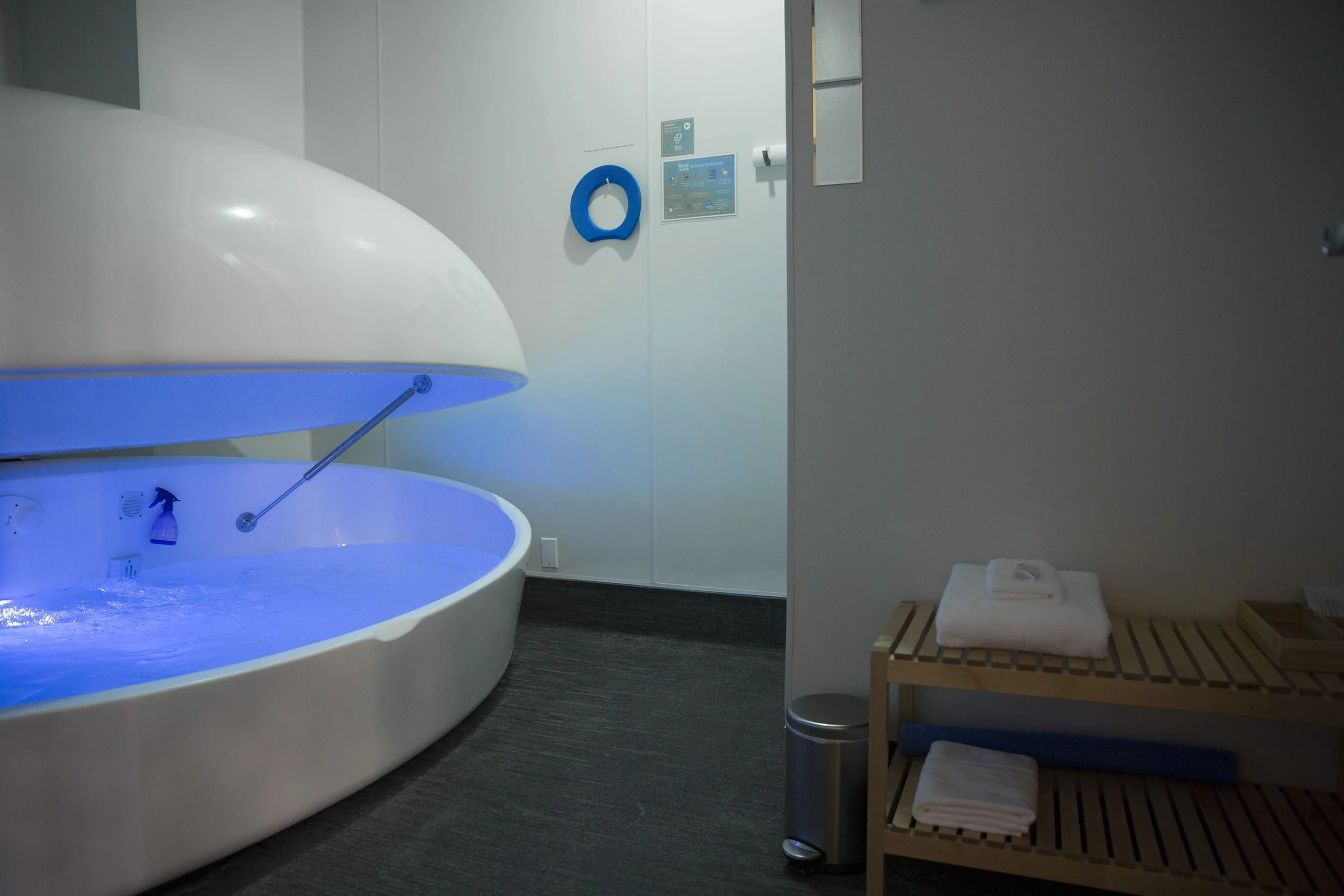
When I open the tank door for the first time during a walkthrough, occasionally an anxious person will physically recoil. It's not subtle. Eyes widen, body pulls back, and the questions come fast. "Wait, does it lock?" "Do I have to close the door?" "What if I panic?"
I've stopped being surprised by this. Claustrophobia, or the fear of it, is one of the most common things people bring with them, and pretending it isn't real does nobody any favors.
So here's the truth: you control everything in there. You can leave the door open. You can leave the light on. You can request music. Nothing locks. Nothing holds you in. You can step out at any moment for any reason.
I will, gently, point you toward going all the way. Lights off, door closed, no music. That's where the real experience lives, and I'll tell you why in a minute. But there's no wrong way to float, and stair-stepping into the full experience is a completely valid path. Some of our most regular, long-term members at our centers started with the light on.
The First Ten Minutes: What's Actually Happening
You climb in. The water is ten inches deep and saturated with about a thousand pounds of Epsom salt, which makes you so buoyant you couldn't sink if you tried. You lie back, and for the first time perhaps ever, gravity stops asking anything of you.
The first few minutes can be a little strange and are usually a little busy. People bounce around. They drift into the walls. It’s okay to feel like a kid for a minute. They adjust their head, their arms, their breath. The body is figuring out what weightless even means, because we don’t get that anywhere else in modern life.
Then, as you start to find stillness, bodily tension subtly (or not-so) reveals itself. The neck. The shoulders. The low back. The jaw. Places you didn't know you were gripping all day, every day. The tank doesn't create the tension, of course. It just removes everything else so the awareness has room to show up.
You turn off the light. You settle. And the breath becomes the anchor.
The Epsom salt and buoyancy help relax your joints and muscles and allow you to let go as you breathe deeper and deeper.
This is the part I want you to hear clearly, because it's where most first-timers get tripped up: the tank does not turn your brain off. There is no magic switch. Anyone telling you otherwise is selling you something.
What the tank does is strip away the noise. No phone. No screen. No conversation. No gravity. No light. No temperature gradient. In that neutral space, your body downshifts because it’s finally allowed, and your mind is left holding whatever thoughts it’s been holding. The work, if you can call it work, is meeting that with the breath, kindness, and a little curiosity instead of forcing anything.
Once you stop trying to make something happen, something usually does.

What Surprises People
The expansiveness. Almost everyone expects the tank to feel small. Tight. Limiting. Within five to ten minutes of settling in, most people report the exact opposite. Without visual reference points and without gravity or other inputs, your sense of where your body ends gets fuzzy in the best possible way. The walls of the tank stop mattering. The room around it stops mattering. It feels enormous in there, like you’re floating peacefully in space.
That shift, from constricting to expansive, is one of the most consistent things first-timers describe. And it's why the people most afraid of the small space often end up loving the float the most. The fear was based on a prediction or assumption. The experience contradicts it within minutes.
I've also noticed something fascinating when partners or friends come in together. It's almost always the more anxious one who walks out raving. The calm friend has a nice float. The anxious one has a revelation. The bigger the gap between where you started and where the tank can take you, the more potent the felt effect.
In a real way, floating functions as exposure therapy for people carrying claustrophobia or general anxiety, without ever feeling like therapy. The environment is so inherently calming that after a few minutes, the nervous system downshifts automatically because there's nothing left to process. We’ve given our bodies the conditions they need to shift into recovery mode.
What Floating Is Not
Floating is not something that happens to you.
The tank doesn't deliver relaxation the way a massage delivers pressure. What it delivers is conditions. Perfectly neutral conditions your body cannot find anywhere else in your life. What you do with those conditions, the breath, the attention, the willingness to actually let go, is the practice.
This is the single most useful reframe I can give you before your first float. If you walk in expecting the tank to do the work for you, you'll probably get out feeling like it didn't quite deliver. If you walk in understanding that the tank is giving your body the space to find its own way back to balance, and that your job is mostly to get out of the way, you'll get something real out of every session.
It's participatory. You bring yourself. The tank holds the space.

After the Float: The Part Nobody Talks About
The float itself is only half the experience. Often less than half.
When you get out, the world is brighter and more textured than you remember. The water from the rinse shower feels different on your skin. The tea in the lounge tastes more potently like itself. Sounds have edges. Colors have weight. There's a presence to ordinary moments that you don't usually get to feel because there's too much noise drowning it out.
This is the proof the reset happened. For an hour, your nervous system didn't have to process anything. When you step back into the world, your senses come back online with more bandwidth, and everything has more to give you.
A lot of people will say their best floats aren't the ones where they had some dramatic experience in the tank. They're the ones where they get home, eat dinner, sit on the couch, and notice they feel like a different person than they were that morning. That's the float doing its work after the float is over.
Give yourself a soft landing afterward if you can. Don't schedule a stressful meeting an hour later. Drink some water. Walk slow. Let it ripple.
What One Float Actually Tells You
Here's something I wish every first-timer knew before they walked in: most people need two or three sessions to really understand what floating does for them.
Your first float teaches your body what weightlessness feels like. It helps you get over your hesitations and the novelty of the environment. Your second teaches you how to relax into it faster. Your third is usually where things start to deepen, because you've built a little muscle memory and you're no longer spending the first twenty minutes figuring out the logistics. And the benefits begin to compound.
Floating is a practice, not an experience. It's closer to meditation, yoga, or therapy, than it is to a spa treatment. One time tells you something. A few times tells you a lot more. A regular rhythm changes your baseline.
If your first float doesn't blow your mind, that's normal and it doesn't mean floating isn't for you. It means you've dipped your toes in. Give it a couple more before you make up your mind.
Who Floating Is Actually For
I won't tell you floating is for everyone, because that's the kind of sentiment that means nothing.
What I will tell you is that floating tends to do the most for people who are willing to look at themselves. People in life transitions. People processing something hard. People carrying chronic pain or chronic stress. People who can feel that the noise of modern life is keeping them from having capacity to show up the way they want to in their own life.
I've introduced creatives, athletes, hardworking professionals, stay-at-home parents, pregnant women, people grieving, people recovering, and people who just felt off and didn't know why. The common thread isn't demographic. It's readiness. A small willingness to slow down and pay attention.
If that sounds like you, the tank will meet you where you are.
A Last Word
The fear or hesitation around the first float is real, and it's also the doorway. I've never had a first-timer walk out and tell me they regretted going through with it. The ones who were most nervous walking in are usually the ones standing in the lounge afterward, drinking tea, asking when they can book the next one.
If you've been thinking about trying it, this is your sign. Book the float. Show up nervous if you have to. Let the tank do what it does best.
Float Seattle has five locations spanning Seattle, Bellevue, and Renton. We're here whenever you're ready.
Buoyantly,
Andrew & the Float Seattle team