Questions, answered
Float FAQ
Everything you might want to know before your first float, and a few things regulars ask too.
Your first float
What is float therapy?
You lie back in about 10 inches of water with a little over 1,000 pounds of Epsom salt dissolved in it, so you float effortlessly. The water is kept at 94°F, the same temperature as your skin, and there's no light or sound. With almost nothing for your body and brain to process, most people settle into deep relaxation and a meditative state.
What's the best way to start?
With our 3-Float Intro Series. It's the one thing we recommend to every new floater.
Your first float is often spent getting used to the experience: the water, the quiet, the feeling of letting go. By your second and third, your body knows what to expect and drops into deep rest faster. Three floats close together is when most people start to feel what floating can really do.
- Buy 2 floats, get the 3rd free (about $60 per float)
- Finish all three within 30 days and your 4th float is free
- Credits are valid for 12 months
What happens during my visit?
Here's how a typical float goes:
- Check in. On your first visit, arrive 10 minutes early so a Float Guide can show you around and give you a thorough walkthrough.
- Remove makeup and contacts. Put your earplugs in before you shower so they go into dry ears.
- Shower in your private room, then dry your face and hairline well.
- Cover any cuts or scrapes with the petroleum jelly we provide, then step into the tank.
- Float for 60 minutes. We recommend dark and quiet, but you can keep the light on or add music if you prefer.
- Gentle music plays at the end to let you know your session is over.
- Shower off the salt, and use the ear wash (a water and vinegar rinse) to clear salt from your ears. Then take your time relaxing with some tea before you head back out.
How long is a float? Can I go longer?
A standard float is 60 minutes in the tank. With your showers before and after, and time to relax in the lounge, plan for at least 90 minutes at the studio. On your first visit, arrive 10 minutes early for your walkthrough.
You can also book back-to-back sessions for up to 2.5 hours (you get the cleaning time in between, too). Choose Pay later when you book online, and we'll add the second hour for $45 ($35 for members).
Members get an extra perk: if nobody is booked after you when you arrive, we'll extend your float for free. It's an easy way to try a 75 or 90 minute float and work your way up. See membership.
What do I need to bring?
Nothing, really. Most people float nude, so no swimsuit is needed. We provide earplugs, ear wash, petroleum jelly, towels, shampoo, conditioner, and body wash, and every bathroom has a hair dryer. You're welcome to bring your own shower shoes or hairbrush.
For your first visit, arrive 10 minutes early so a Float Guide can show you around and give you a thorough walkthrough.
How should I prepare?
- Book a time with some breathing room before and after, so you're not rushing in or out.
- Skip caffeine for a few hours beforehand.
- Don't shave or wax right before. The salt can sting freshly shaved skin.
- Have a cut or scrape? After your pre-float shower, cover it with the petroleum jelly in your room.
- Eat a light meal about 90 minutes before.
What about contacts and makeup?
Before you shower, remove any makeup, oils, and lotion from your face. Every room has makeup wipes and a cosmetic towel.
We recommend taking out contacts before you float. We provide contact solution and cases.
Do I need to know how to swim?
No. The water is only about 10 inches deep, and it holds a little over 1,000 pounds of Epsom salt, so you'll be fully supported. Just lie back and float without any effort.
Do you offer couples floats?
Each tank is for one person, but two of you can book the same time in separate rooms, usually next door or across the hall. Many guests share their experience over tea afterward. You can also share an infrared sauna or Fire & Ice session before your floats with one of our shared combos.
In the tank
Is the water hot or cold?
Neither. The water is kept at 94°F, which is skin-receptor neutral. After a few minutes, it gets hard to tell where your body ends and the water begins.
Can I fall asleep? Is that safe?
Yes, and yes. Plenty of people fall asleep in the tank, and it's often a sign you aren't getting enough sleep otherwise. It's safe: the water is so buoyant that it's hard to turn over even on purpose. The worst that usually happens is you jerk awake and splash a little salt water on yourself.
At the end of your session, gentle music gradually builds to wake up even the deepest sleepers.
What if I get salt in my eyes?
Not much can go wrong in a float tank, but salt in the eyes can happen to the best of us. To avoid it:
- Dry your face and hairline well with the washcloth after your pre-float shower. Droplets on your face start to itch in the humid air, and scratching is how salt water ends up in your eyes.
- Bring your washcloth into the tank and hang it from the handle.
Every tank also has a spray bottle of fresh water. With the washcloth, that's your insurance kit. If it happens, sit up, spray, wipe, and get back to floating.
What if my mind won't settle?
That's completely normal, especially on your first float. Feeling fidgety, or having stretches where your mind races, is part of the process. A few things help:
- Be kind and patient with yourself.
- Treat restless moments as a cue to come back to your breath. Let your breath be your anchor.
- Breathe deep into your belly rather than your chest, and through your nose rather than your mouth.
- Count your breaths if it helps you stay focused.
- Try a slow body scan from head to toe. Breathe into each area, and let go of tension as you breathe out.
It usually gets easier with each float, which is why we recommend starting with three floats close together.
Can I listen to music?
Yes. Every float is silent by default, but you can choose one of our tracks or play your own through our AUX connection. Just let us know before your session. We recommend silence for most guests, especially on your first float. See Music & Audio for tracks and samples.
What if I'm claustrophobic?
It's one of the most common first-timer worries, and most people find the tank feels open rather than confining. You're always in control:
- You can get out at any time.
- You can float with the light on, or leave the lid cracked for more air (it may feel a little cooler).
- You can request audio, either a pre-loaded track or your own playlist through our AUX connection.
We still recommend silence for the most benefit. See Music & Audio for details.
What are the differences between your float tanks?
We have four styles across our studios: Orb, Pod, Cabin, and Traditional. They differ in shape and size, but every one has about 10 inches of water and a little over 1,000 pounds of Epsom salt. See which tanks each studio has on our Locations page. Interior sizes are approximate.
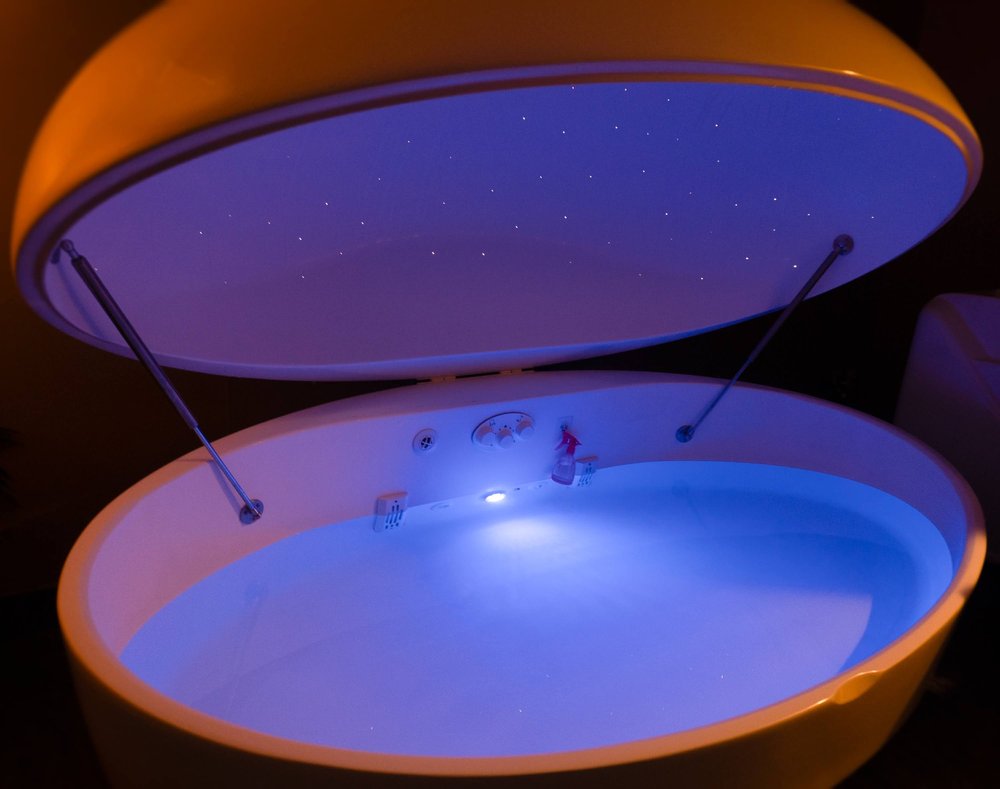
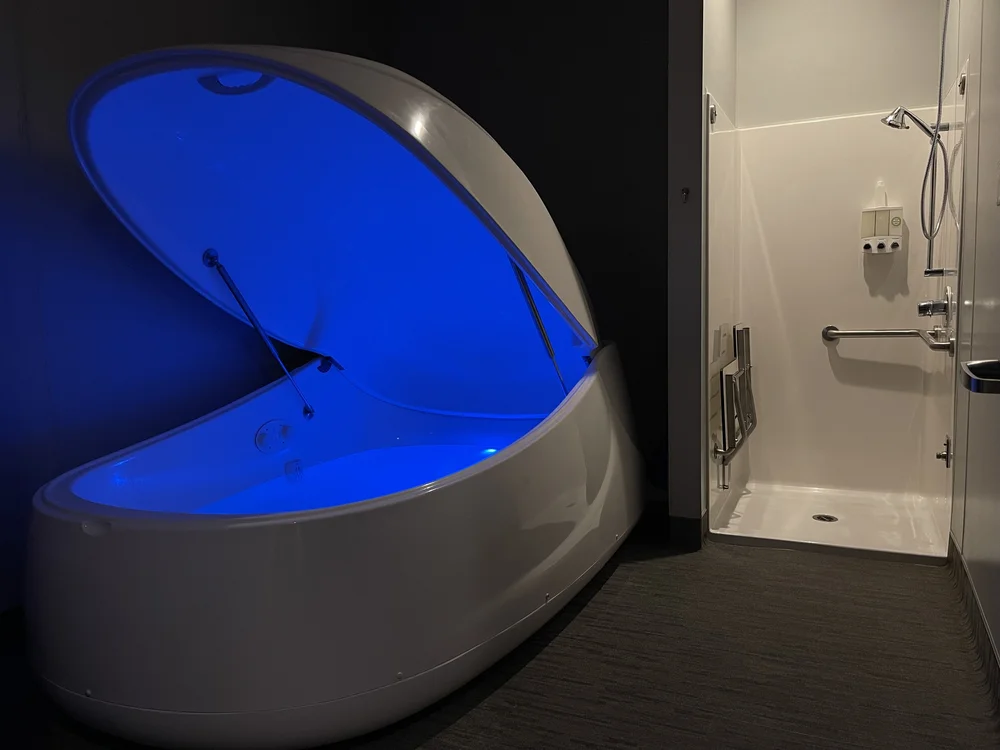
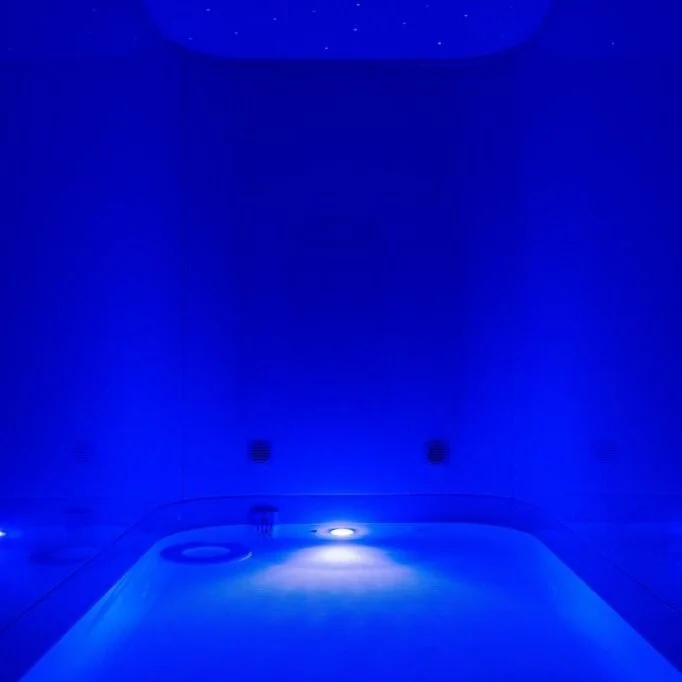
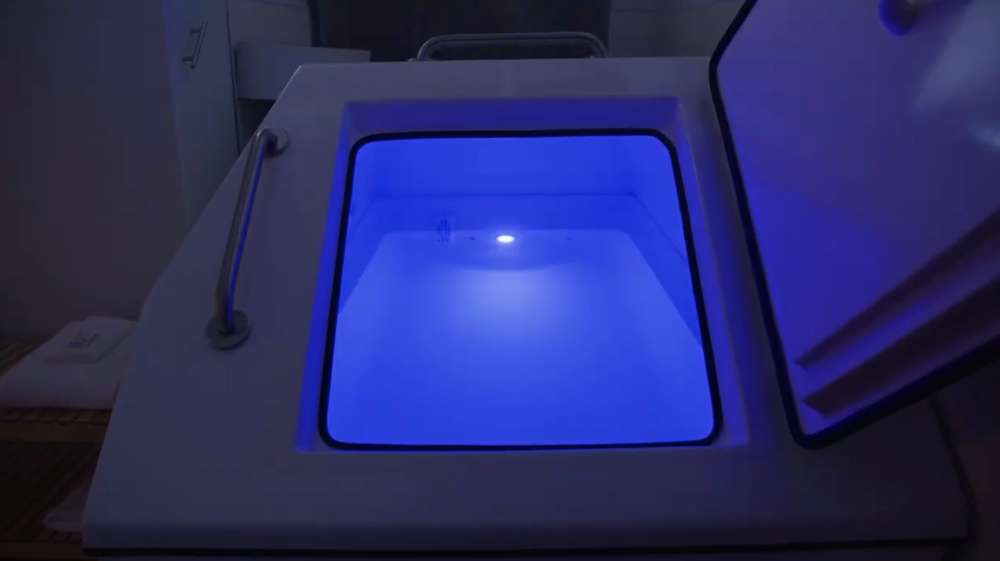
Our Orb, Pod, and Cabin tanks all have low entry points, and every room is private with its own shower.
Want to float under the stars? All five Orbs at Greenwood and the Cabin at Greenlake have an optional starlight ceiling. They're the only tanks with this feature, and you can still float in full darkness if you prefer.
Health & your body
What are the benefits?
At its core, floating is about nervous system regulation. With no light, no sound, and no gravity to fight, your whole system finally gets permission to downregulate. Your body shifts out of fight-or-flight and into a state of deep rest that's hard to reach anywhere else.
That's the benefit everyone gets. Most of the others are a byproduct of it:
- Lower stress and anxiety
- Relief from chronic pain, helped by the buoyancy and magnesium
- Deeper meditation, especially for beginners
- Clearer focus and more creativity
- Better sleep
- Faster athletic recovery
- A steadier mood
Everyone's experience is different, and the effects tend to build with regular floating.
How often should I float?
It's personal, but more floats generally bring more benefit. For newcomers, we recommend three floats in your first three to four weeks. That's usually when people find their own reasons to keep floating.
Most regulars float anywhere from once a week to once a month, and two to four floats a month tends to work best. Some people with chronic pain, and some longtime meditators, float almost daily. Membership makes a regular practice easier.
Just getting started? Our 3-Float Intro Series is built around exactly that first month.
I have high stress or chronic pain. Will floating help?
Many of our guests come in for exactly that, and many report real relief. Floating has been studied for chronic stress, anxiety, insomnia, fibromyalgia, chronic pain, back pain, and multiple sclerosis, and research is ongoing. For current studies, visit clinicalfloat.org.
Are there any reasons I shouldn't float?
Floating may not be a good fit if you have:
- Open wounds or skin conditions, since the salt can irritate them
- A new tattoo that isn't fully healed
- Epilepsy or a seizure disorder, unless it's well controlled and your provider approves
- A severe heart condition (check with your provider first)
- Kidney disease, because of magnesium absorption (check with your doctor first)
- A severe mental health condition (check with your provider first)
For anything not listed here, check with your healthcare provider before booking.
Is there a weight limit?
No strict limit. We've comfortably floated guests up to 325 lbs, NFL linemen included. Since the water is 10 inches deep, comfort depends on your individual size and shape. If you have questions, reach out and we'll help you choose the right tank.
Is floating accessible?
Every one of our studios has an ADA room with a shower bench, grab rails, and a little more space.
Our Pod, Orb, and Cabin tanks all have low entry points and are easy for most people to step in and out of. See which tanks each studio has on our Locations page.
If you need hands-on help getting in or out of the tank, please bring someone with you who can assist. Our team isn't able to provide physical assistance.
Can I float while pregnant?
Many people float during pregnancy and love the weightlessness and relief it brings. Please check with your healthcare provider before you book.
Can I float on my period?
Yes. Come prepared the way you would for a public pool, with a tampon, menstrual cup, or disc. We keep organic cotton tampons in every bathroom.
Can floating cause vaginal irritation?
It's rare, but Epsom salt can irritate sensitive areas, especially for people who are peri- or post-menopausal. Recent sexual activity, some types of contraception, menstruation, or an early UTI or yeast infection can also play a part.
- A brief sting is common and usually fades. If discomfort lasts, get out of the tank and we'll reschedule you at no charge.
- We provide petroleum jelly for sensitive areas, and you can reapply it mid-float.
What if I get motion sickness?
Take a non-drowsy over-the-counter remedy like Bonine or Dramamine beforehand. Some guests also float with the light on. If you start to feel unwell, end your session early and relax on the couch with some tea.
Can I float with a Continuous Glucose Monitor (CGM)?
Possibly, with a few precautions:
- Check with your doctor first.
- Water ratings are for fresh water only. Libre CGMs are rated for up to 30 minutes, and DexCom for up to 24 hours.
- Salt can work its way under the sensor and adhesive, causing irritation or loosening it.
- Waterproof CGM patches can help, but not all of them have been tested in a float tank.
- If you're wearing a CGM short-term, like for a trial, skip floating. For long-term use, get larger waterproof patches and test them in a pool first.
Do you allow kids?
Floaters of all ages are welcome. Our youngest so far was 8.
- Under 18: a parent or guardian must sign the waiver.
- 16 and under: a parent or guardian must stay at the studio during the float.
- 12 and under: a parent or guardian should be in the room during the float.
One thing to be aware of: kids can find it hard to stay still, and moving around can get salt water in their eyes. It stings, but it isn't harmful. Our team will share tips before the float on how to avoid it and what to do if it happens.
Hair, skin & tattoos
I recently colored my hair. Can I still float?
- Bleached or lightened hair: no problem. We don't use chlorine, so your highlights won't turn green.
- Darker or natural tones: wait at least two weeks, until the color no longer runs in the shower or onto towels. This can take up to 30 days.
- Fashion colors: make sure the color no longer bleeds before you book. Dye can stain the tank, the water, and our towels.
- Keratin treatments: most hair professionals advise against salt water exposure, Epsom salt included.
I recently got a tattoo. Can I still float?
Your tattoo needs to be fully healed first, which usually takes 2 to 4 weeks depending on its size and detail. Salt can cause pain and permanent damage to an unhealed tattoo, and any ink or blood in the water means a hefty cleaning fee. Your tattoo artist can tell you when it's ready.
Henna: we generally don't recommend floating with fresh henna. The salt water and humidity can make it bleed or smudge, so wait until it has set or faded.
Cleanliness
How is the water cleaned?
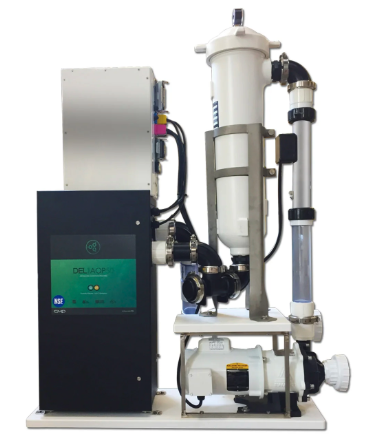
We follow Washington State and King County Health Department standards. Here's how we keep every tank clean:
- Salt: the water is so dense with Epsom salt that bacteria can't thrive, similar to the Dead Sea.
- Filtration: the water cycles through one-micron filters four times between every session.
- Sanitation: an Advanced Oxidation Process combines UV light, ozone, and hydrogen peroxide.
- Testing: water quality is tested and monitored continuously.
Booking & payment
How much does floating cost?
A single 60-minute float is $89. New guests save the most with our 3-Float Intro Series, and members get the best ongoing value. See all pricing and packages.
Do you have memberships?
Yes. Membership starts at $69 a month and includes a float, 25% off all other services, and a free 4th float any month you float 3 times. Members also get free float extensions when nobody is booked after them. See membership options.
Do you take walk-ins?
Rarely, especially on weekends. Our schedule changes quickly, so even if you see an opening online, we can't promise it'll still be there when you arrive. The best way to get in is to book online or give us a call.
Can I use my HSA or FSA?
Yes. Floating and our other recovery services may qualify for HSA or FSA payment, and we accept HSA and FSA cards. Some plans ask for a Letter of Medical Necessity first. See how to use your HSA or FSA.
Do you sell gift cards?
Yes. Our digital gift cards can be scheduled to arrive in their inbox on the day you choose. Shop gift cards.
What else do you offer besides floating?
Besides floating, our studios offer infrared sauna, Fire & Ice (sauna plus cold plunge), red and near-infrared light, Normatec compression boots, and localized cryotherapy. Here's what's available at each studio:
| Service | Greenlake | Bellevue | Greenwood | South Lake Union | Renton Landing |
|---|---|---|---|---|---|
| Float Therapy | |||||
| Infrared Sauna | |||||
| Fire & Ice | Temporarily unavailable | – | |||
| Red / NIR Light | – | – | Coming soon | – | |
| Localized Cryotherapy | – | – | – | – | |
| Compression Boots | – | – | – | – |
Greenlake
Bellevue
Greenwood
South Lake Union
Renton Landing
Learn more about each one on our additional services page.
Where are your studios, and where do I park?
We have five studios: Greenlake, Bellevue, Greenwood, South Lake Union, and Renton Landing. Our Locations page has addresses, hours, parking tips, and the services at each.
Policies
What is your cancellation policy?
Please cancel or reschedule at least 12 hours before your appointment.
- Late cancellations (under 12 hours) and no-shows are charged 50% of the full service price. Members are charged 50% of the member rate.
- Arriving 30 or more minutes late counts as a no-show, and we may not be able to fit in your session.
See our full cancellation policy.
What is your refund policy?
Refunds are available within 90 days of purchase for all services and products, except partially used packages and promotional or discounted items. Unused credits can also be converted to a gift card, which keeps the original expiration date if there is one.
Are there any other rules?
- Keep the water clean: please don't float if you have incontinence, and keep bodily fluids out of the tank. Contaminating a tank can mean a cleaning and salt replacement fee of up to $1,500.
- Alcohol and drugs: we can't serve anyone who is under the influence.
- Illness: if you're sick or contagious, stay home and let us know. We'll cancel or reschedule your session with no fee.
About floating & Float Seattle
How long have people been floating?
Dr. John C. Lilly built the first float tanks in the late 1950s to study what happens to the mind with very little sensory input. From the 1960s on, floating caught on with athletes, meditators, and creatives. Tanks have become much more refined since, with options for lighting, music, and temperature, and clinical research on floating is ongoing.
How long have you been in business?
Since 2012.
- Greenlake
- November 2012
- Bellevue
- July 2015
- Greenwood
- July 2019
- South Lake Union
- October 2021
- Renton Landing
- 2024
I've floated before. How can I go deeper?
Consider a membership to make floating a regular practice, or ask a senior Float Guide for tips on your next visit. Some reading we love:
- The Book of Floating, a complete guide to building a practice
- Floating in Quiet Darkness, a memoir from the early days of floating by Samadhi founders Glenn and Lee Perry
- Floating Tao, for philosophy and inspiration
You can find all three on the retail shelf at every one of our studios.
Still have a question?
Call or text (206) 673-5132, or email guide@floatseattle.com.